Shoaib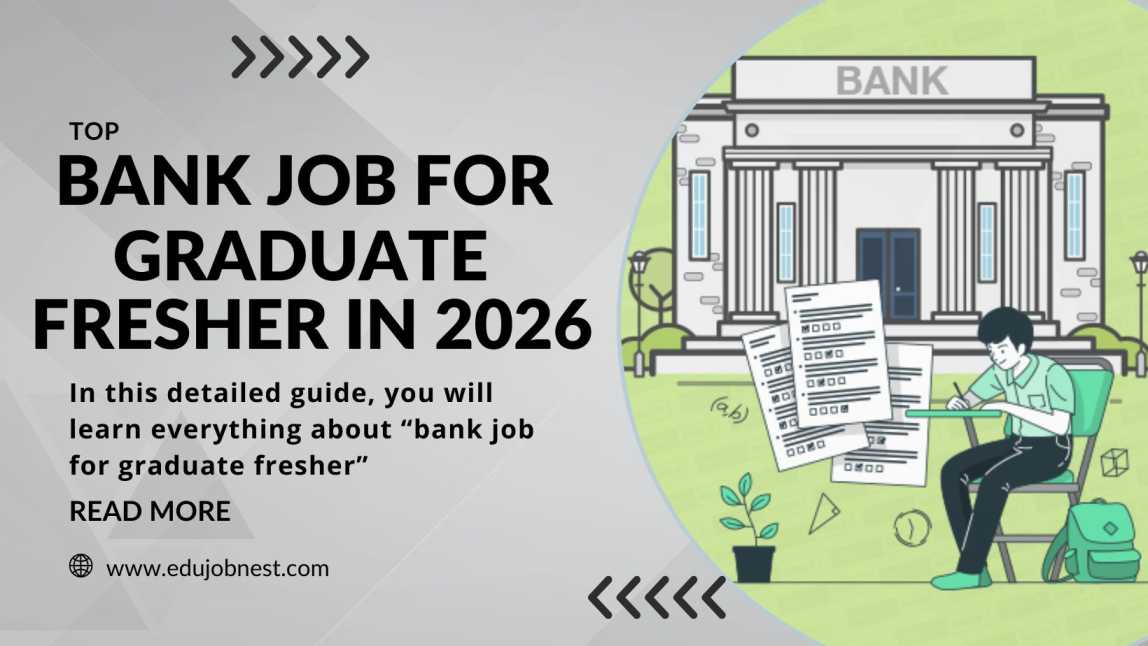
If you are a graduate fresher searching for a secure and fast‑growing career, a bank job is one of the most reliable options in India in 2026. Every year, banks and BFSI companies hire more than a lakh fresh graduates across government and private sectors for different roles like PO, clerk, relationship manager, and operations executive. The best part is that graduates from almost any stream (BA, BCom, BSc, BBA, BTech, etc.) can enter banking with the right exams, skills, and preparation strategy.
In this detailed guide, you will learn everything about “bank job for graduate fresher”: types of jobs, eligibility, salary, exams, private vs government banks, preparation strategy, and how to apply step by step.
Also Read: India Post GDS Merit List 2026: Download Link
Why Bank Job Is a Great Choice for Graduate Freshers
Bank jobs remain one of the most preferred choices for Indian graduates due to stability, growth, and nationwide opportunities. Whether you choose a public sector bank (PSB) or a private bank, you get structured roles, training, and a clear promotion path.
Key reasons why a bank job is ideal for a graduate fresher:
- High job security in public sector and RBI‑regulated environment.
- Regular salary with annual increments, allowances, and retirement benefits in PSBs.
- Fast growth and performance‑linked incentives in private banks and NBFCs.
- Clear hierarchy from entry‑level to branch manager and senior management roles.
- Local posting opportunities as many private banks prefer local candidates for sales and relationship roles.
Types of Bank Jobs for Graduate Freshers
As a fresher, you can target different types of bank jobs based on your interest in sales, operations, customer service, or analysis.
1. Government Bank Jobs (PSU Banks)
These include jobs in SBI, Bank of Baroda, Punjab National Bank, Canara Bank, Indian Bank, and other PSBs. Most recruitment happens through IBPS and SBI exams.
Popular government bank posts for graduates:
- Probationary Officer (PO) – SBI PO, IBPS PO.
- Clerk / Junior Associate – SBI Clerk, IBPS Clerk.
- IBPS RRB PO and Clerk in regional rural banks.
- Specialist Officers (for IT, HR, Marketing, Law) – often need relevant degree.
- RBI Assistant and RBI Grade B (more competitive, higher pay).
- NABARD Grade A (for agriculture/rural background graduates).
2. Private Bank Jobs
Private sector banks like HDFC Bank, ICICI Bank, Axis Bank, Kotak Mahindra Bank, and others recruit freshers throughout the year. Many roles are filled via direct hiring, campus drives, job portals, and bank‑linked training programs.
Common private bank roles for freshers:
- Customer Service Executive / Phone Banking Officer.
- Relationship Manager / Relationship Officer.
- Personal Banker / Assistant Manager – Sales.
- Business Development Executive for CASA, loans, and credit cards.
- Operations Executive / Back Office Executive.
3. BFSI and Allied Financial Roles
Apart from banks, many BFSI companies hire graduates for similar profiles.
You can explore:
- NBFCs (Non‑Banking Financial Companies).
- Housing finance companies (like HDFC Ltd).
- Fintech companies and digital lending platforms.
Eligibility Criteria for Bank Job for Graduate Fresher
Most bank jobs are open to fresh graduates from any stream if they meet basic eligibility.
1. Educational Qualification
- Graduation in any discipline from a recognized university (BA, BCom, BSc, BBA, BCA, BTech, etc.).
- For some specialist roles (IT Officer, Law Officer, Agriculture Officer), relevant degree is mandatory.
- Final‑year students can apply for many bank exams, but they must complete graduation before document verification.
2. Age Limit
- For most government bank exams like IBPS PO/Clerk and SBI PO/Clerk, age is usually 20–30 years, with relaxation for reserved categories as per rules.
- Private bank roles are more flexible; age limits vary but typically accept young graduates in their early to mid‑20s.
3. Basic Skill Requirements
Even as a fresher, you need some essential skills:
- Good communication skills (English and local language).
- Basic computer knowledge (MS Office, email, banking apps).
- Customer handling skills and patience.
- Numerical ability and basic understanding of finance.
Top Bank Posts for Graduate Freshers (With Roles & Salary Overview)
Below is a quick overview of popular bank posts you can target with a graduation degree.
Bank Exams for Graduate Freshers (Government Sector)
If you want a stable government bank job with strong benefits, you must clear competitive bank exams.
Major bank exams after graduation:
- SBI PO and SBI Clerk.
- IBPS PO and IBPS Clerk.
- IBPS RRB PO and Clerk.
- RBI Assistant and RBI Grade B.
- NABARD Grade A (for specific backgrounds).
Common Exam Pattern
Most bank exams follow a similar three‑stage pattern.
1. Prelims Exam
- Objective test with sections like English, Quantitative Aptitude, and Reasoning Ability.
- Short duration with high competition; mainly qualifying.
2. Mains Exam
- Includes Reasoning, Quant, General/Economy Awareness, Computer Aptitude, and English.
- For some posts, includes descriptive English (letter/essay writing).
3. Interview / Final Selection
- For PO/Officer roles, interview or interview + group discussion is conducted.
- For clerical posts, final selection is usually based on Mains score plus language proficiency.
Private Bank Job for Graduate Fresher (Without Competitive Exams)
Many graduates prefer private bank jobs because the hiring process is faster and does not always require national‑level exams.
You can get a private bank job as a fresher through:
- Direct applications on bank career pages (e.g., HDFC current vacancies).
- Job portals like Indeed and Naukri where banks and partners post fresher roles.
- Bank‑linked training programs that offer classroom training plus placement assistance.
- Campus placements at colleges where private banks conduct recruitment drives.
Private bank hiring focuses more on communication skills, sales attitude, and basic computer proficiency than on written exams.
Skills Needed for Bank Job for Graduate Fresher
To stand out among thousands of applicants, you must work on a few core skills that banking recruiters check.
Important skills:
- Communication skills – clear speaking, active listening, and polite handling of customers.
- Sales and persuasion ability for relationship and business development roles.
- Basic accounting and numerical comfort for handling transactions.
- Computer literacy (MS Excel, email, bank CRM/portal usage).
- Problem‑solving and conflict resolution for complaint handling.
- Time management and target orientation, especially in private banks.
How to Get a Bank Job as a Graduate Fresher: Step‑By‑Step Roadmap (2026)
Use this practical, stepwise roadmap if you want to crack a bank job in 2026 as a fresher.
Step 1: Choose Your Target – Government or Private Bank
- If you want high job security, fixed working culture, and long‑term benefits, target government bank exams like SBI, IBPS, RRB, RBI, NABARD.
- If you want quick joining, performance incentives, and faster promotions, target private bank roles.
You can also prepare for government exams while working in a private bank to get experience and income.
Step 2: Understand Eligibility and Deadlines
- Check notification details for SBI, IBPS, RBI, NABARD for age limits, category relaxations, and exam dates.
- For private banks, regularly track their official career pages and job postings for fresher openings.
Step 3: Build Core Skills During Graduation
Start improving your profile even before final year:
- Take basic courses in banking, financial markets, and MS Excel.
- Practice English communication and interview skills.
- Join internships or part‑time roles in finance, if available.
Step 4: Prepare Smartly for Bank Exams (If Targeting Govt Jobs)
For exams like SBI PO, IBPS PO/Clerk, follow a structured plan.
- Understand detailed syllabus and exam pattern from official notifications.
- Make a daily schedule for Quant, Reasoning, English, and GK/GA.
- Solve previous year papers and take online mock tests regularly.
- Analyze mock tests to identify weak topics and improve speed and accuracy.
Free mock tests and exam‑oriented platforms are very helpful to assess your level and competition.
Step 5: Apply to Private Banks and BFSI Roles in Parallel
Even while you prepare for government exams, you can start applying to private bank jobs as a fresher.
- Create a simple but professional CV highlighting communication skills, computer knowledge, and any sales or customer exposure.
- Apply via bank career pages like HDFC, ICICI, Axis, Kotak etc., and via job portals.
- Keep your LinkedIn profile updated if you are open to BFSI and fintech roles.
Step 6: Prepare for Bank Interviews and GD
Most private banks and PO roles conduct interviews (and sometimes group discussions).
Focus on:
- Basic banking awareness – savings account, current account, loans, credit cards, digital banking.
- Your strengths, weaknesses, and why you want to join banking.
- Role‑play scenarios like handling an angry customer or cross‑selling a product.
- Formal dressing and confident body language.
Salary of Bank Jobs for Graduate Freshers
Salary depends on whether you join a public sector bank, RBI/NABARD, or a private bank.
Approximate starting ranges:
- Public sector bank clerk: around entry‑level pay with additional allowances as per bank and city; overall package is attractive due to stability and benefits.
- Public sector bank PO: higher starting pay than clerks, plus perks, allowances, and faster growth.
- Private bank officer / relationship manager: often in the 20K–40K per month range for freshers, with performance incentives.
- BFSI sales roles: similar or slightly lower fixed pay, but higher incentives based on targets.
Over time, government bank employees benefit from promotions, pension/retirement schemes, and job security, while private bank professionals may see rapid CTC growth if they perform well.
Government Bank vs Private Bank for Freshers
Both options have pros and cons, and your choice should match your priorities.
Common Mistakes Graduate Freshers Make While Targeting Bank Jobs
Avoid these mistakes to improve your chances of getting a bank job quickly.
- Preparing for bank exams without understanding the exact syllabus and pattern.
- Ignoring mock tests and attempting exams without speed and accuracy practice.
- Applying to private bank roles with a poorly written CV and no clarity on career goals.
- Not working on communication skills and interview preparation.
- Waiting for “perfect” government job and not exploring private or BFSI options in parallel.
Practical Tips to Improve Selection Chances as a Fresher
You can follow these actionable tips while still in college or as a recent graduate.
- Start preparing for bank exams at least 6–12 months before the expected notification.
- Give regular online mock tests and full‑length practice exams.
- Maintain a simple, clean, one‑page resume focusing on skills, projects, and internships.
- Learn Excel formulas, basic accounting terms, and digital banking concepts.
- Do short online certifications related to banking or financial services.
- Network with seniors and professionals on LinkedIn working in banks.
How to Apply Online for Bank Job for Graduate Fresher
The application process differs slightly between government bank jobs and private bank roles.
1. Applying for Government Bank Exams
- Visit official websites like IBPS, SBI Careers, RBI, and NABARD for notification and online application forms.
- Register with basic details, upload photo, signature, and required documents as per guidelines.
- Pay the application fee online and download the confirmation and future admit cards.
- Keep checking email and SMS for exam date, admit card release, and result updates.
2. Applying for Private Bank Jobs
- Visit careers pages of leading banks like HDFC, ICICI, Axis, Kotak etc., and check “current vacancies”.
- Apply for relevant profiles like “Retail Branch Banking”, “Relationship Manager”, “Customer Service Officer”, “Phone Banking”.
- Also apply via trusted job portals where banks and partners advertise fresher openings.
- Some banks and training institutes run job‑linked programs for fresh graduates with assured interviews.
Best External Resources for Bank Job Preparation (Outer Links)
You can deepen your preparation using reliable external resources:
- Detailed guide on bank jobs after graduation, including roles and steps for freshers: https://bygc.co/blog/bank-job-after-graduation/
- In‑depth article on job opportunities in the banking sector after graduation: https://www.careerguide.com/career/working-professionals/job-opportunities-in-the-banking-sector-after-graduation
- HDFC Ltd careers page to understand real‑time openings and job descriptions for fresher roles: https://www.hdfc.com/careers/current-vacancies
These links help you understand real job profiles, salary trends, and recruiter expectations so you can plan more effectively as a fresher.
Frequently Asked Questions: Bank Job for Graduate Fresher
1. Can I get a bank job as a fresher without experience?
Yes, many government and private bank roles are specifically for fresh graduates without prior experience, provided you clear the exam or interview process.
2. Which is the best bank job after graduation?
Popular choices include SBI PO, SBI Clerk, IBPS PO, IBPS Clerk, RBI Assistant, RBI Grade B, NABARD Grade A, and officer/relationship manager roles in private banks.
3. Can final‑year students apply for bank exams?
Most bank exams allow final‑year students to apply if they complete graduation before document verification and meet all eligibility conditions.
4. Do private banks require bank exam scores?
No, private banks usually conduct their own short tests, group discussions, and interviews instead of national‑level exams like IBPS/SBI.
5. Is banking a good long‑term career for graduates?
Yes, banking offers a stable, well‑structured career path with multiple promotion levels, skill growth, and opportunities to switch between retail, corporate, and digital banking domains.
About the Author